lmnature · Molecular biology · Page 9
Calmodulin and calcium: four EF-hand loops
Media: text, diagrams, video and live animation.
The pinned 1CLL coordinate file reports 1.70 Å resolution and four calcium ions. This page compares two named oxygen positions at each of its four file-annotated sites. These eight distances are selected measurements, not a complete coordination shell.
Measured geometry
We compute full three-dimensional Euclidean distances between heavy atoms. Paired B-factors below are in Ų, in calcium/oxygen order. All selected atom occupancies are 1.00. The second decimal is arithmetic rounding, not coordinate precision.
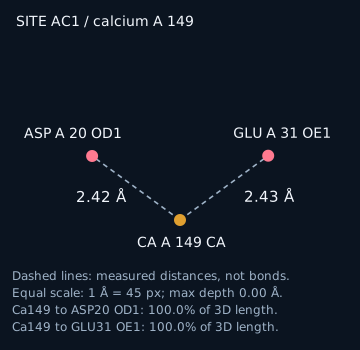
- CA A 149 CA to ASP A 20 OD1: 2.42 Å; B-factors 12.07 / 15.48 Ų.
- CA A 149 CA to GLU A 31 OE1: 2.43 Å; B-factors 12.07 / 9.39 Ų.
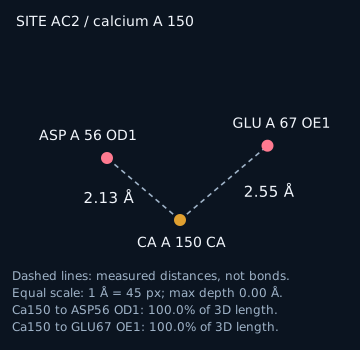
- CA A 150 CA to ASP A 56 OD1: 2.13 Å; B-factors 13.42 / 9.18 Ų.
- CA A 150 CA to GLU A 67 OE1: 2.55 Å; B-factors 13.42 / 15.62 Ų.
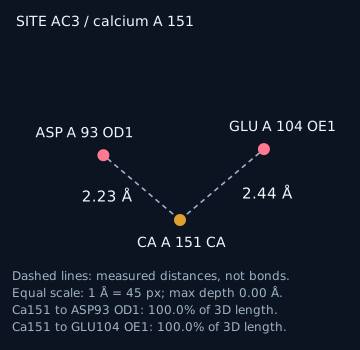
- CA A 151 CA to ASP A 93 OD1: 2.23 Å; B-factors 25.88 / 28.58 Ų.
- CA A 151 CA to GLU A 104 OE1: 2.44 Å; B-factors 25.88 / 26.70 Ų.
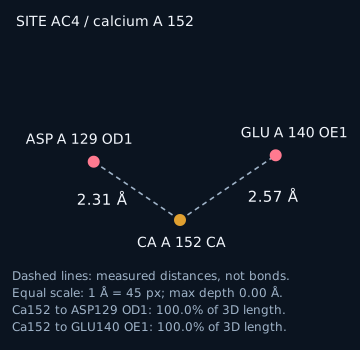
- CA A 152 CA to ASP A 129 OD1: 2.31 Å; B-factors 29.77 / 28.49 Ų.
- CA A 152 CA to GLU A 140 OE1: 2.57 Å; B-factors 29.77 / 26.44 Ų.
Four local views
Each panel has its own local axes through its calcium and the two selected oxygen positions. The panels share an equal scale; their placement does not show the relative orientation of the four sites in the protein. Labels give full 3D distances.
What the deposited file records
Chain A uses deposited PDB numbering. DBREF declares residues 1–148; coordinates exist for 144 protein residues, 4–147. Residues 1, 2, 3 and 148 are missing. Calcium residues A 149–152 are hetero records, not protein sequence positions. COMPND marks the molecule ENGINEERED. REMARK 350 describes an author-determined monomer; no symmetry copies are added. Source: deposited 1CLL records.
The file contains 1133 ATOM and 146 HETATM records, including four calcium ions, 139 water oxygens and three records of an EOH fragment. One EOH record is hydrogen. Raw alternate-location records comprise three A and three B positions at ASP A 118, each with occupancy 0.50. We retain blank/A conformers, never choose by highest occupancy, and exclude hydrogen from measurements. The renderer omits waters but retains the deposited EOH fragment, including its hydrogen and its CONECT sticks. None of the selected atoms is alternate. Source: pinned coordinate file.
There are 28 LINK, 39 CONECT and 8 SITE lines. SITE AC1–AC4 identify the four loop neighborhoods. All eight selected pairs occur in both LINK and CONECT. Each calcium has seven LINK oxygen partners: six protein oxygen atoms and one water. The file records these connections; neither their presence nor our distances establish bond order or biological function. The annotations in the video are measured geometry, independently of these deposited records. Source: LINK, CONECT and SITE records.
Source-supported interpretation
Chattopadhyaya, Meador, Means and Quiocho describe two calcium-binding EF-hand loops in each calmodulin lobe. This is the cited authors’ structural interpretation, separate from our distance arithmetic. Calmodulin structure refined at 1.7 A resolution, Journal of Molecular Biology (1992), PMID 1474585.
We also checked 1EXR, a higher-resolution entry. It contains five calcium ions, so it is not the four-ion example used here. The deposited coordinates alone do not establish affinity, cooperativity or a functional response; this page shows one static snapshot, not molecular motion or binding events.
Video and live view: explicit measurements
Gold lines draw exactly the eight quoted Ca–O pairs with explicit measure annotations. Automatic green contacts are disabled at a 0.0 Å cutoff. The C-alpha trace, calcium ions, retained non-water hetero atoms and the named oxygen endpoints provide context. This is not a complete oxygen shell or a simulation.
Live: orbit it yourself
Heavy-atom distances are geometric measurements, not inferred bonds. A single static snapshot; no atom moves.
Papers the corpus links to this protein
The corpus ER record for P62158 is not available in this snapshot; its paper count is unknown. This is not evidence that no papers exist. No accession alias has been inferred. Corpus cross-references are not necessarily about this structure.
No corpus record is available for a title lookup.