lmnature · Molecular biology · Page 5
Potassium ions and oxygen positions in the KcsA filter
Media on this page: text, diagram, video, and live animation.
This page measures selected heavy-atom distances in the deposited KcsA structure 1BL8. The coordinate file reports 3.20 Å resolution. RCSB PDB 1BL8 records the structure and its experimental metadata.
What was measured
Each value below is the straight-line distance between two heavy-atom coordinates in 1BL8. Measurements are in Å; paired B-factors are in Ų. The article associated with this structure is Doyle et al., Science, doi:10.1126/science.280.5360.69, PMID 9525859.
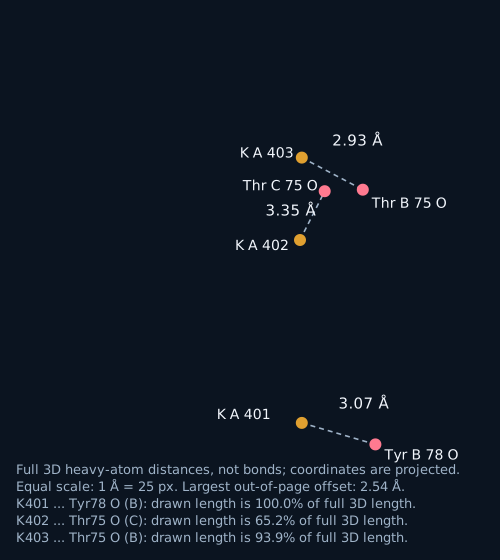
- K401 ... Tyr78 O (B) — 3.07 Å; B-factors 57.73 / 53.28 Ų
- K402 ... Thr75 O (C) — 3.35 Å; B-factors 74.76 / 65.21 Ų
- K403 ... Thr75 O (B) — 2.93 Å; B-factors 75.52 / 73.54 Ų
The coordinate model has 3.20 Šresolution. For these measured pairs, K-ion B-factors range from 57.73 to 75.52 Ų and oxygen-atom B-factors range from 53.28 to 73.54 Ų. Nearby filter atoms Gly B 77 O and Gly A 77 O have B-factors 130.62 and 148.34 Ų. These positions are approximate at this resolution; the second decimal is arithmetic, not coordinate precision. Source: 1BL8 PDB coordinates.
What the file records
The pinned file contains 2820 ATOM records and 4 HETATM records, including three K ions and one water; it has 26 LINK, 30 CONECT, and 8 SITE records. It has no alternate-location atoms and no hydrogen atoms. Its four chains (A–D) are in the asymmetric unit; REMARK 350 describes a tetrameric biological unit. The file's SITE annotations include SEL and AC1–AC3. Source: 1BL8 PDB records.
A short stick between K A 402 and K A 403 appears in the video because the file contains reciprocal CONECT records 2826–2827 and 2827–2826. That stick comes from the input records; it is not a measurement. This page reports K…O distances only.
For each ion, the selected oxygen is the nearest carbonyl O among the Thr, Val, Gly, and Tyr filter residues across chains A–D in the pinned coordinates. Source: 1BL8 PDB coordinates.
What this does and does not show
The video displays these three selected K…O measurements as explicit annotations, including distances above its automatic-contact cutoff. Other green contacts are selected by the 3.0 Å cutoff. A fixed coordinate model cannot show ion movement or explain why the filter is selective. This page makes no claim about the mechanism of selectivity. Doyle et al.
Video: rotating presentation of the fixed coordinate model
Gold lines explicitly mark the three measured K…O distances; they are independent of the 3.0 Å automatic-contact cutoff. Green contacts use that cutoff. The short K402–K403 stick comes from the file's CONECT records, not from a measured distance.
Live: orbit it yourself
Heavy-atom distances are geometric measurements, not inferred bonds. A single static snapshot; no atom moves.
Papers the corpus links to this protein
The corpus links 12 papers across 1 UniProt entry (P0A334); per-protein counts: P0A334: 12. These papers are cross-referenced by the corpus and are not necessarily about this structure.
Titles, journal and year load from Europe PMC when JavaScript is available.