lmnature · Molecular biology · Page 2
Two hemoglobin chains, two measured oxygen pockets
Media on this page: text, diagram, video and live animation are available.
Hemoglobin carries oxygen in red blood cells. Adult hemoglobin contains two alpha chains and two beta chains; each chain has a heme group (Shaanan 1983, J. Mol. Biol. 171, 31–59). The RCSB PDB 1HHO entry is human oxyhaemoglobin, determined by X-ray diffraction at 2.10 Å resolution.
This page compares alpha chain A (UniProt accession P69905, 141 residues) with beta chain B (UniProt accession P68871, 146 residues). Chain identities and residue counts come from the entry’s DBREF and SEQRES records.
Two pockets in one coordinate set
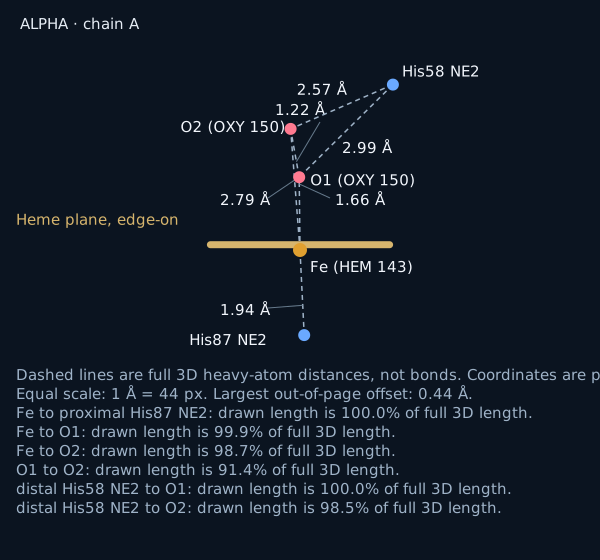
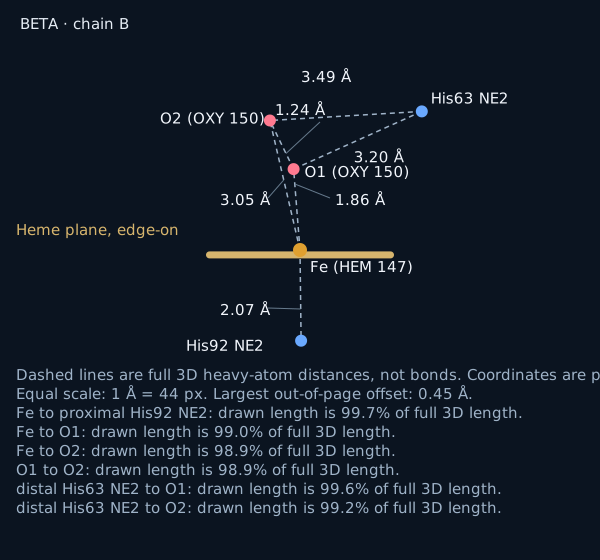
Every value here is a heavy-atom distance computed from deposited coordinates. Fe in HEM 143 is 1.94 Å from proximal His87 NE2, 1.66 Å from O1 and 2.79 Å from O2; O1 and O2 are 1.22 Å apart. Distal His58 NE2 is 2.99 Å from O1 and 2.57 Å from O2. Fe in HEM 147 is 2.07 Å from proximal His92 NE2, 1.86 Å from O1 and 3.05 Å from O2; O1 and O2 are 1.24 Å apart. Distal His63 NE2 is 3.20 Å from O1 and 3.49 Å from O2.
Video: a turn around the two-chain structure
Rendered with public lmvideo v0.1.126 from videos/mb02.lms and the same pinned 1HHO file.
What a distance comparison can say
The two modeled pockets have different coordinate distances. That describes this deposited snapshot; the measurements do not explain why the values differ or establish what caused them. The file’s LINK records list each heme iron with its proximal histidine NE2 and O1; chain A also lists O2. Its CONECT records list each iron with the four heme nitrogens, proximal His NE2 and O1, and list O2 for chain A. These are records in the source file, separate from the distances recomputed here.
Precision: the structure was solved at 2.10 Šresolution. Oxygen B-factors are 17.77 and 33.84 Ų in alpha chain A, and 42.12 and 37.44 Ų in beta chain B. The coordinate file contains no hydrogen atoms; the second decimal is arithmetic formatting, not measurement certainty.
The coordinate file also records phosphate group PO4 A 142 at occupancy 0.50. Its phosphorus atom is identified separately in the video legend; the group is not among the twelve selected measurements.
Not shown: the coordinate file’s asymmetric unit contains chains A and B. REMARK 350 describes a tetrameric biological assembly and a crystallographic twofold operator that generates a second alpha-beta pair. This page measures only the deposited asymmetric-unit chains; it does not show motion or oxygen arriving or leaving.
Live: orbit it yourself
Heavy-atom distances are geometric measurements, not inferred bonds. A single static snapshot; no atom moves.
Papers the corpus links to this protein
The corpus links 243 papers across 2 UniProt entries (P68871, P69905); per-protein counts: P68871: 137; P69905: 116. These papers are cross-referenced by the corpus and are not necessarily about this structure.
Titles, journal and year load from Europe PMC when JavaScript is available.
- PMID 20980
- PMID 108887
- PMID 186485
- PMID 429365
- PMID 478975
- PMID 478977
- PMID 486536
- PMID 635569
- PMID 668922
- PMID 721609
- PMID 826083
- PMID 849454
- PMID 891976
- PMID 893142
- PMID 902765
- PMID 992050
- PMID 1019344
- PMID 1115799
- PMID 1138922
- PMID 1177322
- PMID 1182166
- PMID 1195378
- PMID 1247583
- PMID 1301199
- PMID 1390940
- PMID 1390944
- PMID 1428941
- PMID 1428950
- PMID 1428951
- PMID 1487420
- PMID 1507231
- PMID 1511986
- PMID 1512262
- PMID 1517102
- PMID 1520632
- PMID 1540659
- PMID 1567857
- PMID 1575724
- PMID 1618774
- PMID 1634355
- PMID 1634357
- PMID 1634363
- PMID 1634367
- PMID 1686260
- PMID 1787097
- PMID 1802882
- PMID 1814856
- PMID 1917530
- PMID 1917537
- PMID 1917539
- PMID 1971109
- PMID 2079430
- PMID 2079432
- PMID 2079435
- PMID 2101836
- PMID 2101840
- PMID 2108715
- PMID 2384314
- PMID 2399911
- PMID 2513289
- PMID 2581851
- PMID 2599879
- PMID 2599880
- PMID 2599881
- PMID 2606724
- PMID 2634665
- PMID 2634669
- PMID 2634671
- PMID 2752146
- PMID 2833478
- PMID 3142772
- PMID 3384707
- PMID 3384708
- PMID 3384709
- PMID 3384710
- PMID 3557994
- PMID 3623975
- PMID 3654264
- PMID 3654265
- PMID 3666141
- PMID 3691763
- PMID 3707969
- PMID 3718478
- PMID 3744871
- PMID 3754244
- PMID 3754246
- PMID 3838976
- PMID 3937824
- PMID 3973024
- PMID 4123689
- PMID 4129558
- PMID 4212045
- PMID 4521212
- PMID 4528583
- PMID 4531009
- PMID 4555506
- PMID 4639022
- PMID 4667378
- PMID 4744335
- PMID 4824923
- PMID 4850241
- PMID 4852224
- PMID 5033650
- PMID 5085669
- PMID 5091982
- PMID 5115619
- PMID 5288820
- PMID 5440849
- PMID 5780195
- PMID 5919752
- PMID 5988206
- PMID 6166590
- PMID 6166632
- PMID 6188720
- PMID 6244294
- PMID 6254664
- PMID 6259091
- PMID 6434492
- PMID 6452630
- PMID 6526652
- PMID 6526653
- PMID 6539334
- PMID 6547117
- PMID 6547932
- PMID 6618888
- PMID 6629822
- PMID 6629823
- PMID 6629824
- PMID 6687721
- PMID 6714429
- PMID 6725558
- PMID 6726807
- PMID 6815131
- PMID 6857757
- PMID 6874376
- PMID 6874377
- PMID 6882779
- PMID 6946451
- PMID 7068434
- PMID 7068437
- PMID 7161106
- PMID 7161109
- PMID 7173395
- PMID 7213661
- PMID 7238856
- PMID 7238857
- PMID 7275660
- PMID 7338468
- PMID 7338469
- PMID 7358733
- PMID 7373648
- PMID 7410435
- PMID 7435503
- PMID 7448866
- PMID 7462179
- PMID 7470621
- PMID 7558876
- PMID 7693620
- PMID 7713747
- PMID 7786798
- PMID 8111050
- PMID 8144352
- PMID 8148419
- PMID 8195005
- PMID 8237999
- PMID 8280608
- PMID 8294199
- PMID 8294200
- PMID 8330972
- PMID 8330974
- PMID 8330979
- PMID 8377203
- PMID 8401300
- PMID 8448109
- PMID 8493987
- PMID 8522332
- PMID 8602627
- PMID 8637569
- PMID 8641705
- PMID 8642597
- PMID 8704193
- PMID 8718692
- PMID 8745430
- PMID 8745434
- PMID 8798486
- PMID 8811317
- PMID 9322075
- PMID 9452028
- PMID 9494044
- PMID 9521756
- PMID 9665850
- PMID 9761252
- PMID 9830011
- PMID 9843411
- PMID 10206681
- PMID 10398311
- PMID 10569720
- PMID 10569723
- PMID 10588683
- PMID 11001883
- PMID 11157797
- PMID 11300344
- PMID 11300351
- PMID 11402454
- PMID 11410421
- PMID 11747442
- PMID 11939514
- PMID 12144064
- PMID 12149194
- PMID 12454462
- PMID 12470213
- PMID 12552433
- PMID 12603091
- PMID 12665801
- PMID 12908805
- PMID 13464827
- PMID 13872627
- PMID 13897827
- PMID 13954546
- PMID 14093912
- PMID 14576901
- PMID 14702039
- PMID 15481886
- PMID 15489334
- PMID 15495251
- PMID 15616553
- PMID 15921163
- PMID 16001361
- PMID 16175509
- PMID 16728641
- PMID 16904236
- PMID 17676725
- PMID 18077343
- PMID 19453576
- PMID 19608861
- PMID 21269460
- PMID 24100324
- PMID 24275569
- PMID 25944712
- PMID 25946035
- PMID 26209877
- PMID 28066926
- PMID 29109153